From Toothache to Mediastinum: How Odontogenic Infections Escalate Through Fascial Spaces

June 26, 2026

A neglected molar can seed descending necrotizing mediastinitis (DNM) with a roughly 17 to 25 percent mortality rate, or septic cavernous sinus thrombosis (CST) with mortality near 20 percent, inside of days. By the time the patient arrives in the emergency department with chest pain, hoarseness, or proptosis, the dental story can sound incidental. It is not. This article is a quick anatomic and clinical refresher for ED physicians, hospitalists, ICU intensivists, and OMFS-curious colleagues who want a clean escalation framework for the next patient who walks in with a swollen face and a worried partner.


Fascial-Space Anatomy: The Elevator Shafts

Odontogenic infections do not respect skin. Once a periapical abscess perforates cortical bone, the path of least resistance is dictated by fascia. The spaces that matter for escalation include the canine and buccal spaces (superficial, usually self-limiting), the sublingual and submandibular spaces (the Ludwig's angina bed), the lateral pharyngeal (parapharyngeal) space (a four-sided pyramid that abuts the carotid sheath), the retropharyngeal space (stops at T2 to T4), and the so-called danger space, the fourth fascial space described by Grodinsky and Holyoke, which runs between the alar and prevertebral fascia from the skull base down to the diaphragm.

That last detail is the clinical pearl: the danger space is a continuous corridor from neck to chest. Roughly 70 percent of mediastinal seeding from oral sources travels via the retropharyngeal or danger space route, with smaller fractions through the pretracheal space and the carotid sheath. Gravity and the negative intrathoracic pressure of inspiration pull purulent material inferiorly. There is no functional valve between the floor of the mouth and the mediastinum.

Tooth-to-space mapping is worth memorizing. Mandibular second and third molars drain into the sublingual and submandibular spaces, which is why those teeth dominate Ludwig's presentations. The mandibular third molar can also track through the masticator space into the parapharyngeal, retropharyngeal, and danger spaces, the classic DNM pathway. Maxillary anterior teeth and canines drain through the canine and infraorbital spaces into the facial vein and pterygoid plexus, both valveless, and from there into the cavernous sinus.


The Cascade: Pulpitis to Mediastinitis in Days

The progression is rarely as dramatic as the name suggests. Pulpitis becomes a periapical abscess. The abscess perforates bone and seeds the surrounding fascial space as cellulitis. Cellulitis becomes a deep neck space infection. From there the patient develops one of four major complications: descending necrotizing mediastinitis, septic cavernous sinus thrombosis, Lemierre's syndrome (internal jugular vein thrombophlebitis with septic pulmonary emboli), or cervical necrotizing fasciitis. The interval from first toothache to ICU admission can be as short as 72 hours in healthy adults and shorter still in patients with poorly controlled diabetes or immunosuppression.

Bacteriology is polymicrobial. Most cultures grow four to six organisms with anaerobes outnumbering aerobes about two or three to one. The usual suspects are Prevotella, Peptostreptococcus, Fusobacterium, Porphyromonas, and the viridans and anginosus streptococci. Lemierre's is overwhelmingly Fusobacterium necrophorum. CST skews toward Staphylococcus aureus. Diabetic Ludwig's tends to add Klebsiella. Empiric coverage at the front door is typically ampicillin-sulbactam, or clindamycin plus ceftriaxone if penicillin-allergic, escalated to piperacillin-tazobactam or a carbapenem plus vancomycin if the patient is septic or has resistance risk factors.


DNM Red Flags Worth Stopping For

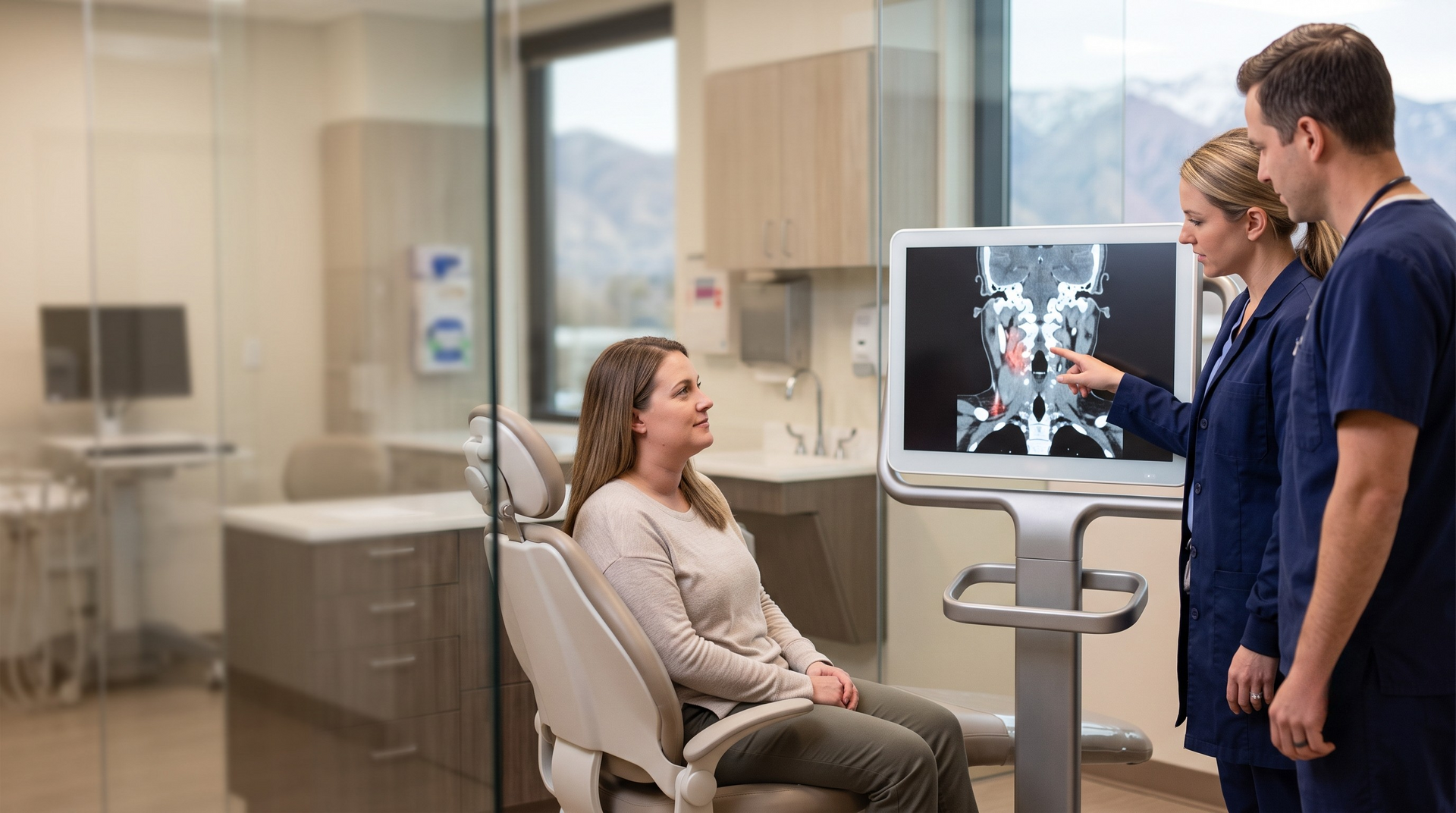
Submandibular swelling in a patient with a recent toothache, plus any of the following, should drive low-threshold contrast CT from skull base to diaphragm: dyspnea, dysphagia, hoarseness, anterior neck crepitus, chest or interscapular pain, trismus, fever above 38.5 degrees Celsius, or unexplained leukocytosis. A normal chest X-ray is not reassuring. CXR lags imaging-positive DNM by 24 to 48 hours in published series. The Estrera criteria (1983) remain the standard diagnostic framework, and the Endo classification (1996) guides surgical approach: Type I disease above the carina can sometimes be drained from the neck alone, while Type IIA and IIB disease below the carina almost always requires thoracotomy or video-assisted thoracoscopic drainage. If you are about to discharge a patient with a stabilized periapical infection, source control still has to happen, and antibiotics alone will not cure them. The Emergency Dentist is open seven days a week in Salt Lake City and accepts walk-ins, so the necrotic pulp can come out before the patient bounces back to your department.


CST Red Flags Worth Stopping For

A patient with a maxillary toothache in the past week who now presents with unilateral periorbital swelling, proptosis, chemosis, or a sixth cranial nerve palsy (often the first ocular motor nerve affected, followed by III and IV) needs immediate imaging. MRI of the brain with magnetic resonance venography is the test of choice. CT venography is reasonable as a second-line study. Non-contrast CT and time-of-flight MRV will miss CST, so order the right protocol the first time. Anticoagulation with heparin in addition to broad-spectrum antibiotics has been associated with mortality dropping from roughly 40 percent to 14 percent and neurologic morbidity from 61 percent to 31 percent in pooled series, though randomized data remain limited.


Mortality and the Role of Source Control

Modern mortality figures are sobering: Ludwig's angina runs 4 to 8 percent in well-resourced centers (compared with greater than 50 percent in the pre-antibiotic era), DNM sits at 17 to 25 percent and climbs above 40 percent with delayed drainage, CST runs 8 to 20 percent, Lemierre's runs 4 to 9 percent, and cervical necrotizing fasciitis hovers around 21 percent overall and 30 percent in diabetics. One number changes practice: in cervical necrotizing fasciitis, the published mortality is 19 percent when surgical drainage occurs within six hours of presentation and 32 percent when it is delayed past six hours. Time to source control is the dominant modifiable variable.

Definitive source control is dental. Antibiotics cannot sterilize a necrotic pulp or an avascular abscess cavity. Same-day extraction or incision and drainage shortens length of stay by about two days in published cohorts and has been associated with an 88 percent reduction in 30-day readmission. Calling OMFS or a same-day dental partner during the initial ED workup, not after admission, is consistently associated with better outcomes.


A Printable Escalation Tree for the Department

  1. Airway first. Floor-of-mouth firmness, tongue elevation, drooling, or a "hot potato" voice is Ludwig's until proven otherwise. Awake fiberoptic intubation with surgical airway backup. Page OMFS now.
  2. Labs and cultures. CBC, lactate, blood cultures times two, BMP, coags, glucose, type and screen, beta-hydroxybutyrate in diabetics.
  3. Empiric IV antibiotics within one hour of arrival: ampicillin-sulbactam 3 g IV, or clindamycin 900 mg plus ceftriaxone 2 g if penicillin-allergic. Escalate to piperacillin-tazobactam plus vancomycin if septic.
  4. Imaging. Contrast CT of the neck and chest (skull base to diaphragm) for any deep-neck or DNM concern. MRI brain plus MRV if maxillary tooth plus orbital findings or cranial nerve palsy.
  5. Consults. OMFS plus ENT for deep neck and DNM. Add cardiothoracic surgery for any mediastinal involvement. Add neurology and consider hematology for CST and heparinization decisions.
  6. Disposition. ICU for any airway, mediastinal, CST, or necrotizing fasciitis concern. Operating room for same-admission extraction plus drainage. Do not discharge without a documented dental source-control plan.

If your patient is stable enough to discharge once the airway and systemic infection are controlled, getting the offending tooth managed quickly is the part that often falls through the cracks. The Emergency Dentist is open seven days a week, including evenings and weekends, and accepts ED referrals and walk-ins so source control happens before the next admission. A printable version of the escalation tree above can be requested for break-room walls.


You might also like

May 27, 2026
A child arrives in your emergency department with a permanent front tooth in a sandwich bag. The parents are frightened, the clock is running, and most emergency physicians have never reimplanted a tooth. That is the gap this protocol is built to close. Tooth avulsion is one of the few emergencies where the first 60 minutes genuinely decide the long term result, and where a confident clinician with no specialized dental training can change the outcome. This is a working reference for emergency physicians, urgent care clinicians, EMS crews, and school nurses across the Salt Lake City area. It follows the International Association of Dental Traumatology (IADT) 2020 avulsion guidelines, so whatever you do in the first hour lines up with what the dentist does next.  Why the 60-minute window matters An avulsed permanent tooth is not just a tooth. Clinging to its root surface are periodontal ligament (PDL) cells, and their survival is what lets a reimplanted tooth heal back into the bone normally. Those cells are fragile. They begin to die within minutes of dry exposure, and after roughly 60 minutes of total dry time they are considered non-viable regardless of how the tooth is stored afterward. When PDL cells die, the body cannot rebuild a normal attachment. Instead the root fuses directly to bone and is slowly replaced by it, a process called replacement resorption, or ankylosis. It is progressive and largely irreversible. A separate problem, inflammatory resorption, is driven by a necrotic pulp and bacterial toxins; unlike ankylosis, it is preventable with timely root canal therapy. That is why two things protect the tooth independently: keeping PDL cells alive, and handing the case to a dentist fast enough for definitive endodontic care. The single most useful fact you can capture on arrival is the extra-oral dry time. Time out of the mouth, time in a storage medium, and the type of medium together tell the dentist whether to expect favorable healing or to plan for managed ankylosis. Maturity matters too: closed-apex (mature) teeth will need root canal treatment, while open-apex (immature) teeth in younger patients may revascularize and are watched rather than treated immediately. The IADT 2020 storage hierarchy If a caller reaches you before they arrive, the storage medium is the highest-value instruction you can give. The IADT hierarchy, best to last resort, is straightforward: Cold milk. Widely available, close to the right osmolality, and forgiving. This is the realistic best choice for most families. Hank's Balanced Salt Solution (HBSS). The ideal medium, sold in tooth-preservation kits, though rarely on hand at home. The patient's own saliva. Tucked in the buccal vestibule between cheek and gums, only for a cooperative patient who will not swallow or aspirate it. Sterile saline. Acceptable for short periods and usually available in your department. Water. Last resort only. It is severely hypotonic and ruptures PDL cells, although it still beats letting the tooth air-dry on a counter. The message for parents, coaches, and school staff is simple: never let the tooth dry out, never scrub it, and get it into milk on the way to care. The field protocol your ER can run For a permanent tooth within the viable window, reimplantation is a procedure you can perform. The IADT sequence is consistent across every source: Handle the tooth by the crown only. Never touch or wipe the root surface. If visibly contaminated, rinse gently with sterile saline. Do not scrub, curette, or disinfect the root, and do not remove tissue attached to it. Reposition any displaced socket bone and irrigate the socket with saline to clear clot debris. Replant the tooth slowly into its original socket with light digital pressure until it seats. Verify position clinically and, where available, radiographically. Have the patient bite gently on gauze to stabilize the tooth. Apply a passive, flexible splint for about 2 weeks. Extend toward 4 weeks if there is an associated alveolar fracture or if dry time exceeded 60 minutes. A flexible splint can be improvised with thin stainless steel wire bonded with composite, nylon fishing line and composite, or a prefabricated titanium trauma splint. The goal is stability with slight physiologic movement, never rigid fixation. Not sure whether to replant in the department or send the patient straight over? A 60-second call to our team gets you a real-time answer and a same-day slot. We would always rather talk it through with you first than have a tooth lost to hesitation. Adjuncts that protect the result A few low-effort steps meaningfully improve healing. Check and update tetanus status, especially when the injury involved soil or a dirty surface. Systemic antibiotics are recommended after replantation; amoxicillin or penicillin is a typical first choice, and tetracyclines such as doxycycline are generally avoided in younger children because they can permanently discolor developing teeth. A chlorhexidine 0.12% rinse twice daily reduces bacterial load at the site. Advise a soft diet for about 2 weeks and meticulous, gentle oral hygiene around the splint. When not to replant One contraindication is absolute: never replant an avulsed primary (baby) tooth, because it can damage the developing permanent tooth bud beneath it. Relative contraindications include severe untreatable caries or advanced periodontal disease in the avulsed tooth, a markedly uncooperative patient where the attempt is unsafe, and severe medical compromise or immunosuppression. When replantation is not appropriate, preserve the tooth in milk and arrange prompt dental evaluation anyway, since the dentist may still have options. The same-day dental handoff Your work buys the tooth time; the dentist makes it permanent. On handoff, the practice confirms or adjusts the splint and plans definitive care by apex maturity. For a closed-apex tooth, root canal therapy is planned deliberately, with pulp extirpation generally around 7 to 10 days after replantation and before the splint comes off, which heads off inflammatory resorption. Open-apex teeth are monitored for revascularization instead. A structured recall follows: roughly 2 weeks for splint removal, then 4 weeks, 3 months, 6 months, 1 year, and yearly thereafter. Skipped follow-up is independently linked to losing the tooth, so the handoff is not a formality; it is the rest of the treatment. This is exactly where an emergency dental practice open 7 days a week earns its place in your referral pathway. Avulsions do not wait for Monday, and neither does the 7 to 10 day endodontic window. Call us first, before the parents Google it When an avulsed tooth comes through your doors, you do not have to manage it alone. Our team provides emergency dental care in Salt Lake City every day of the week, including evenings and weekends, and we welcome direct calls from ED and urgent care clinicians mid-case. Tell us the dry time, the storage medium, and the patient's age, and we will give you a clear next step and a same-day appointment. Save our number where your team can find it fast, because the best outcomes start with a quick call to an emergency dentist in Salt Lake City rather than a frantic search. Call us first, and we will take it from there.
May 14, 2026
When the Abscess Becomes the Airway: 5 Red Flags ER Clinicians Cannot Miss in Ludwig's Angina A 47 year old construction worker walks into the emergency department complaining of a "really bad toothache" that started four days ago. He has been swishing salt water and taking ibuprofen. He thinks the swelling under his jaw is a swollen gland. He cannot quite close his mouth. He keeps spitting into a paper cup because swallowing hurts. His voice sounds like he has a marble under his tongue. He is leaning forward in his chair, refusing to lean back for the bed. That patient does not have a swollen gland. He has Ludwig's angina, and the next 30 to 60 minutes will decide whether he goes to the ICU intubated or to the morgue. Why this still kills people in 2026 Ludwig's angina is a rapidly progressive bilateral cellulitis of the floor of the mouth that simultaneously involves the submental, sublingual, and submandibular fascial spaces. Pre-antibiotic mortality ran around 50 percent, driven almost entirely by asphyxia. With modern airway management, broad-spectrum IV antibiotics, and surgical source control, contemporary mortality is roughly 8 percent in pooled reviews, and as low as 0 to 4 percent when airway control is established early. The catch is timing. Once late airway signs appear, definitive airway control is needed in minutes, not hours. Acute loss of the airway during attempted intubation is itself a documented mode of death, which is why awake fiberoptic technique, sitting position, and a surgical airway primed at the bedside are non negotiable. The anatomy that drives the danger The submandibular space is divided by the mylohyoid muscle into a sublingual compartment above and a submaxillary compartment below. The two communicate freely around the posterior border of the mylohyoid, and the submandibular space communicates anteriorly with the submental space past the anterior belly of the digastric. Picture a horseshoe of inflammation wrapping under the mandible: bilateral submandibular swelling, anterior submental fullness, and elevation of the tongue and floor of the mouth. Spread is directed posteriorly and superiorly because the mandible and the unyielding deep cervical fascia bound the swelling inferiorly. Once posterior, the infection can enter the parapharyngeal and retropharyngeal spaces, encircle the airway, and track via the danger space into the mediastinum to cause descending necrotizing mediastinitis. In adult cases, 70 to 90 percent are odontogenic. The mandibular second and third molars dominate because their root apices sit below the mylohyoid line, so a periapical abscess perforates the lingual cortex directly into the submandibular space. If you see a patient with bilateral submandibular swelling and a neglected lower molar, the working diagnosis is Ludwig's until proven otherwise. 5 red flags the ER cannot miss Each of these is mechanism based, not pattern matched, and each predicts how the airway will fail. Tripod posture or refusal to lie supine. The patient leans forward with hands on knees, sniffing position. Mechanism: supine positioning lets the engorged tongue and woody floor of mouth fall posteriorly into the oropharynx and complete the obstruction. A patient who refuses to lie flat is telling you the airway is precarious. Do not force supine for a CT, an exam, or anything else until the airway is controlled. Drooling and pooling of secretions. Mechanism: the inflamed, displaced tongue and sublingual swelling cause mechanical dysphagia and odynophagia. The patient cannot coordinate swallowing of saliva. Drooling implies the upper airway is now too narrow or painful to clear secretions and predicts imminent aspiration. "Hot potato" or muffled voice. Mechanism: the elevated tongue base and supraglottic edema dampen the voice as if the patient has food in the mouth. This is supraglottic, not glottic. It localizes the obstruction to the tongue base and vallecula, exactly where Ludwig's compromises the airway. Frank stridor is an even later sign and warrants an immediate definitive airway. Elevated, brawny ("woody") floor of mouth with tongue elevation. The pathognomonic finding. Bilateral sublingual cellulitis under the tongue is bounded by the mylohyoid below and mucosa above, so pressure has nowhere to go but up and back, pushing the tongue against the palate and toward the posterior pharynx. Bimanual palpation, one finger intraoral and one submental, confirms induration crossing the midline. Fluctuance is usually absent because this is phlegmon, not a drainable abscess. Progressive trismus. Mechanism: inflammation reaches the medial pterygoid muscle and the parapharyngeal space, causing painful spasm. Trismus signals posterior extension, which is the step before airway encirclement. Operationally it also forecloses oral intubation, mandating nasal fiberoptic or surgical airway planning now. Other ominous signs that should trigger immediate airway preparation: stridor at rest, drooling with cyanosis, accessory muscle use, anxiety, swelling crossing midline, swelling extending below the hyoid, crepitus suggesting necrotizing fasciitis, and the "bull neck" of submental and submandibular fullness obliterating the mandibular angle. Diabetes, present in roughly one third of hospitalized series, and immunosuppression amplify the risk and broaden the microbiology. The airway plan: awake, sitting up, double setup Standard of care for a fully developed Ludwig's airway is awake flexible fiberoptic nasotracheal intubation with the patient sitting upright in a sniffing position, topicalized with nebulized lidocaine, pre-medicated with glycopyrrolate 0.2 mg IV to dry secretions, with a surgeon scrubbed at the bedside and a tracheostomy tray open on the prepped, marked neck. What to avoid is just as important as what to do: Supine positioning outside of a controlled, ready-to-cut setting. The woody floor of mouth obliterates the oropharynx the moment the patient lies flat. RSI with paralytics. Removing the patient's own tone in a distorted pharynx invites a true cannot intubate, cannot oxygenate scenario. Blind nasal intubation. Bleeding into an already distorted airway converts a difficult intubation into a catastrophic one. Supraglottic rescue devices (LMA, i-gel). They cannot seal a distorted pharynx and are displaced as swelling progresses. They are only a transient bridge while the surgeon cuts. Repeated failed oral attempts. Each pass worsens edema. Abandon the oral route early when the floor of the mouth is elevated. Awake tracheostomy under local becomes the primary plan, not the rescue, when trismus precludes topicalization, when nasal anatomy is hostile (recent epistaxis, coagulopathy, gross edema), or when stridor and drooling are already present. One tertiary series reported 20 percent of Ludwig's patients required tracheostomy. While the team and the trays are coming together, dexamethasone 8 to 10 mg IV, nebulized epinephrine, heliox, and high flow nasal oxygen buy time but do not substitute for definitive control. Heavy sedation does not buy time. It removes tone and ends the patient. Antibiotics, imaging, and source control After airway assessment and blood cultures, start ampicillin-sulbactam 3 g IV q6h as the preferred single-agent empiric regimen. Piperacillin-tazobactam 4.5 g IV q6 to 8h is a reasonable alternative. In true penicillin allergy, clindamycin 600 to 900 mg IV q8h has historically been used, but rising community resistance among Prevotella means it is increasingly paired with a fluoroquinolone or with metronidazole plus ceftriaxone. Add vancomycin or linezolid for MRSA risk: injection drug use, immunocompromise, recent hospitalization, severe sepsis, or failure to improve at 48 hours. CT neck with IV contrast is the imaging study of choice once the airway is secured. It defines spaces involved, distinguishes phlegmon from a drainable collection, and screens for caudal extension toward the mediastinum. The workflow has to be airway first, then CT. Supine CT positioning in a patient who is already tripoding has been documented to precipitate airway loss. Point of care ultrasound of the floor of mouth and submandibular region is a useful adjunct in the patient who cannot tolerate supine, and a chest film on arrival plus serial repeats screens for the widened mediastinum that announces descending necrotizing mediastinitis. Source control has two layers. OMFS or ENT performs bilateral submandibular incisions through the mylohyoid into the sublingual space, debrides, and places drains. Crucially, the offending tooth should come out in the same anesthetic when possible. Inadequate source control, meaning failing to extract the infected tooth or failing to drain all involved spaces, is the most commonly cited cause of treatment failure. ICU cohort data show average hospital length of stay around 4.6 days and ICU length of stay around 3.1 days when source control is prompt. The infected tooth is the engine of the infection. Removing it shortens the stay. If you are an ED or urgent care clinician in the Salt Lake City area and you have a patient with severe lower molar pain and early facial swelling who is not yet airway threatened, call us before you admit. Same-day extraction and source control of a pre-Ludwig's odontogenic infection is a disposition partner you can actually use. Where a local emergency dentist fits in the pathway Ludwig's angina is never a single-service problem. ED owns the rapid airway assessment, the awake fiberoptic with anesthesia, the first dose of antibiotics, the CT once safe, and the ICU disposition. OMFS or ENT owns the OR for deep neck drainage, deep cultures, and ideally the dental extraction in the same anesthetic. The local emergency dentist owns the post-acute side: definitive evaluation of the offending tooth and the adjacent teeth, completion of any extractions the OR team deferred, periapical and panoramic imaging, restoration planning, and prevention of recurrence. The earlier touch point matters too. A patient with severe lower-molar pain, mild facial swelling, no trismus, no floor-of-mouth induration, and no airway compromise is the pre-Ludwig's patient. A same-day emergency dentist can extract the tooth, drain the source, and send the patient home on oral antibiotics in hours rather than days. That is the call that prevents the next intubation. The bottom line Ludwig's angina rewards pattern recognition and punishes complacency. The five red flags (tripod posture, drooling, hot potato voice, woody floor of mouth, progressive trismus) tell you the airway is closing. The plan is awake fiberoptic in a sitting patient with a surgeon scrubbed, broad-spectrum IV antibiotics started immediately, CT only after the airway is safe, OMFS or ENT for deep-neck drainage, and same anesthetic extraction of the offending tooth when feasible. The Emergency Dentist is open 7 days a week in the Salt Lake City area, including evenings and weekends, for the dental side of this pathway. Call us when you see the swelling, not after you intubate. The earlier we get the tooth out, the less likely the next patient with that tooth ends up in your resus bay.
April 28, 2026
Dental pain has a way of making people bargain with themselves. Maybe it will calm down after one more dose of over-the-counter medicine. Maybe it is just a sensitive tooth. Maybe it can wait until Monday, payday, or the next opening at a regular dental office. Sometimes mild sensitivity is not urgent. But pain that is getting stronger, swelling that is starting to show, or a tooth that hurts enough to interrupt sleep can be a warning sign that something deeper is happening. Reacting early and getting the right dental procedure done quickly can help stop a manageable dental problem from becoming a much scarier medical situation later.  Why Dental Pain Should Not Be Ignored Tooth pain is often the body's alarm system. A cavity may have reached the nerve. A crack may have opened a path for bacteria. An old filling or crown may have failed. Gum swelling may mean infection is building around the root of a tooth. The problem is that dental infections rarely stay still forever. A small pocket of infection can become an abscess. An abscess can create pressure, swelling, fever, and severe pain. In more serious cases, infection can spread into the jaw, face, neck, or bloodstream. When that happens, the situation may no longer be only a dental emergency. It can become a medical emergency. That is why waiting is risky. Pain may come and go, but the cause often keeps progressing in the background. The ER Can Help With Medical Danger, But It Usually Cannot Fix the Tooth Hospital emergency rooms are essential when dental infection is affecting breathing, swallowing, consciousness, or the rest of the body. If you have rapidly spreading swelling, swelling under the tongue, difficulty breathing or swallowing, fever, confusion, or a feeling that you may faint, you should seek emergency medical care right away. But for many dental emergencies, the ER has a limitation: it usually cannot perform dental treatment. An ER may be able to provide temporary medication, evaluate serious symptoms, or stabilize a dangerous situation. It usually cannot remove the infected nerve from a tooth, drain a dental abscess through dental treatment, repair a cracked tooth, place a crown, or remove a tooth that cannot be saved. That means many people leave the ER still needing urgent dental care. Early dental treatment can help you avoid that extra step when there are no medical red flags yet. Dental Procedures That Can Stop the Problem at the Source The right procedure depends on what is causing the pain. That is why a dental evaluation and X-ray matter. Once the source is identified, treatment can focus on stopping the problem instead of only masking symptoms. Common emergency dental procedures include: Root canal treatment: If infection or inflammation has reached the nerve inside the tooth, a root canal can remove the infected tissue, relieve pressure, and help save the tooth. Dental extraction: If a tooth is too damaged or infected to save, removing it can stop the source of infection and pain. Abscess drainage: When appropriate, draining an abscess can reduce pressure and help control infection. Crown or temporary stabilization: A cracked or broken tooth may need protection quickly so the fracture does not worsen. Filling or lost-crown repair: Exposed tooth structure can become painful fast. Restoring coverage can reduce sensitivity and protect the tooth. These are the kinds of treatments that can change the course of the problem. Pain medication may help you get through a few hours, but dental treatment addresses why the pain is happening. How Tooth Problems Can Start Affecting the Rest of the Body Your mouth is connected to the rest of your body through blood vessels, nerves, soft tissues, and the airway. When dental infection spreads beyond the tooth, symptoms can begin to show up outside the mouth. Warning signs can include: Swelling that moves into the cheek, jaw, neck, or under the tongue Fever, chills, or feeling generally ill Difficulty opening the mouth Trouble swallowing Breathing changes or tightness in the throat Dizziness, confusion, or weakness These symptoms should be taken seriously. They can suggest that infection or inflammation is no longer limited to one tooth. If breathing, swallowing, or alertness is affected, go to the ER immediately. When to Call an Emergency Dentist First If you have severe dental pain but you are breathing normally, swallowing normally, and do not have rapidly spreading swelling or serious whole-body symptoms, an emergency dentist is often the best first call. The goal is to treat the source before it turns into something larger. Call for same-day emergency dental care if you notice: Throbbing tooth pain that is getting worse Pain that wakes you up or keeps you from sleeping A cracked, broken, or knocked-out tooth A pimple-like bump on the gum Swelling around one tooth or one side of the face A lost filling or crown with sharp pain or sensitivity Pain when biting that feels new or intense These symptoms do not always mean the worst case scenario, but they do mean the tooth should be checked quickly. The earlier the problem is treated, the more options you may have. Early Treatment Can Be Less Scary Than Waiting People often delay care because they are worried about cost, fear, or being told they need a major procedure. That is understandable. But waiting can make the eventual visit more stressful, not less. A tooth that might have needed a filling can progress toward a root canal. A tooth that might have been saved can become an extraction. A localized infection can become swelling that sends you to the ER first. Early care gives the dental team a chance to explain what is happening, control pain, and choose the most conservative appropriate treatment. It can also help you avoid spending hours in a hospital waiting room only to be told you still need a dentist. If dental pain is escalating, do not wait for it to become unbearable. Same-day emergency dental treatment can help stop the problem before it affects more than your tooth. What to Do While You Arrange Care While you are waiting to be seen, keep things simple and safe. Rinse gently with warm salt water, keep your head elevated, avoid chewing on the painful side, and follow the label directions for over-the-counter pain relievers you can normally take. Do not place aspirin directly on the gum or tooth, and do not poke, squeeze, or try to drain a swollen area yourself. Watch your symptoms closely. If swelling spreads quickly, if swallowing becomes difficult, if breathing feels different, or if fever and confusion appear, go to the emergency room. Same-Day Help in Salt Lake City The Emergency Dentist in Murray serves patients across the Salt Lake City metro with same-day emergency dental care, extended evening hours, weekend availability, and Sunday appointments. Walk-ins are welcome, and our team is used to helping people who are scared, tired, and in pain. Whether the right answer is a root canal, extraction, abscess treatment, repair for a broken tooth, or another procedure, the first step is finding out what is actually causing the pain. Financing as low as 0% interest for 12 months is available through our payment partners, and some plans offer $0 down payments for those who qualify. If your tooth pain is getting worse, do not wait for it to become an ER-level problem. Call our Salt Lake City area emergency dental team or walk in today so we can help you get relief and protect your health.